
Hawkish tone likely to guard rupee from further slide

Retail inflation rose 4.38 per cent year-on-year in November, the slowest pace in data going back to January 2012.

The Reserve Bank of India had taken steps to tighten liquidity in a bid to curb volatility in the forex market after the rupee fell to a record low of 61.21 to the dollar on July 8.

The steep fall in rupee came on a day when the Reserve Bank of India in its first quarter review of monetary policy kept the all key rates unchanged but cut the gross domestic growth forecast to 5.5 per cent for FY'14 from 5.7 per cent earlier.

Standard Chartered on Friday lowered India's growth forecast for the current financial year to 4.7 per cent from earlier 5.5 per cent, citing "upside risks" to inflation and fiscal deficit.
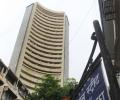
An action on the rate front is unlikely to figure in Rajan's plan for the moment.

RBI Governor Raghuram Rajan on Tuesday kept the repo rate unchanged 6.50 per cent.
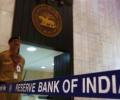
Repo rate may well end 2013 at 8 per cent, where it had begun the year.
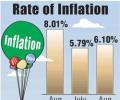
Costlier onion and other vegetables pushed up inflation for the third month in a row to 6.1 per cent in August, making it difficult for the RBI to cut rate in the monetary policy review due later this week.

India's manufacturing sector activity witnessed a significant loss of growth momentum in May due to the intensification of the COVID-19 crisis and its detrimental impact on demand, a monthly survey said on Tuesday. The seasonally adjusted IHS Markit India Manufacturing Purchasing Managers' Index (PMI), fell to 50.8 in May, down from 55.5 in April, as companies observed the slowest rises in new work and output in ten months amid intensification of the COVID-19 crisis. In PMI parlance, a print above 50 means expansion while a score below 50 denotes contraction.
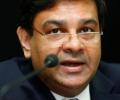
For July-September, it pegged CPI-based retail inflation at 4.2 per cent which it saw firming up to 4.8 per cent in the second half of the current fiscal.

The WPI has been in the negative zone since November.

It is the six per cent target RBI is more concerned about.

The HSBC/Markit purchasing managers index for the manufacturing industry stood at 50.1 in July, slightly more than 50.3 in June, indicating a broad stagnation of manufacturing operating conditions in India.

NCAER said the monetary policy measures are unlikely to revive growth at this juncture and suggested providing fiscal stimulus, which too can be challenging unless it can be financed through better revenue generation.

India Inc has pitched for rate cut to boost economic activities.

Ahead of RBI policy meet, India Ratings said an interest rate hike of 0.50 per cent in the remaining part of the fiscal will throw the BSE 500 companies into a quandary.

On one hand, Operation Greens should help to smoothen volatility in the prices of vegetables, whereas the proposal to enhance and extend minimum support prices to augment farmer incomes, may emerge as an inflation risk.

Market participants attribute the stability to the Reserve Bank of India's timely intervention in the foreign exchange market, both in terms of selling and buying dollars.

Foreign investors have pulled over Rs 6,400 crore from the Indian equity market in the first four trading sessions of the ongoing month when the Reserve Bank of India (RBI) and US Federal Reserve raised interest rates. Given the headwinds in terms of elevated crude prices, inflation, tight monetary policy among others, FPIs' flows in India are expected to remain volatile in the near term, Shrikant Chouhan, Head - Equity Research (Retail), Kotak Securities, said. Foreign Portfolio Investors (FPIs) remained net sellers for seven months to April 2022, withdrawing a massive amount of over Rs 1.65 lakh crore from equities. This was largely on the back of anticipation of a rate hike by the US Federal Reserve and due to the deteriorating geopolitical environment following Russia's invasion of Ukraine.

Rajan had overturned the majority opinion of the members and chose to hold the rates at the last monetary policy review in October.
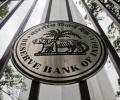
The Reserve Bank of India kept interest rates unchanged at 8.0 percent on Tuesday as widely expected, staying focused on containing inflation while adopting a more dovish tone in response to the government's call for help to revive economic growth.

The decisive election victory for the Narendra Modi-led National Democratic Alliance has created a conducive environment for policy actions and should help in economic recovery, Reserve Bank of India Governor Raghuram Rajan said on Tuesday.

Elections may be a few months away, but the government may get into election mode much earlier than that, predicts A K Bhattacharya.

The index monitoring new business fell to a six-month low of 51.6 from March's 53.5, prompting some firms to cut jobs.
Higher for longer' may be the narrative in the developed markets, but interest rates might not stay high for very long in India, with a section of the market expecting rate cuts to begin this year. The six-member Monetary Policy Committee of Reserve Bank of India (RBI) decided to keep interest rates unchanged at 6.5 per cent in the April review - after hiking the policy repo rate in six previous meetings. RBI Governor Shaktikanta Das emphasised that the pause was only for the April policy and that the central bank was ready to act if the situation demanded.

A fall presents an opportunity to buy rate-sensitive stocks.

Finance Minister Nirmala Sitharaman will kick start the customary pre-Budget consultation exercise with stakeholders from Wednesday by holding the first such meeting with experts of agriculture and agro-processing industry. She will be seeking inputs from various stakeholders, including industry bodies, farmer organisations and economists for reviving consumption and boosting growth hit by the COVID-19 pandemic. The growth this year is expected to be in the double-digit during the current fiscal.

Reserve Bank-sponsored professional forecasters on Monday scaled down India's growth projection to 4.8 per cent for the current fiscal from 5.7 per cent estimated earlier.
.jpg)
The rupee is set to breach the Rs 60-a-dollar mark again this week as the Street expects foreign institutional investors to continue pulling out of domestic markets. According to the street, this would result in government bond yields rising.

Shifting its stance of monetary policy towards targeting retail inflation as it is an "inequitable tax", RBI today said it may exceed 8 per cent by March end and efforts will continue to bring it down.

Achieving inflation target of 4 per cent, recovery after remonetisation and hardening profile of oil prices are some of the risks which the RBI is watching closely, says Gaurav Kapur.

The central bank had nudged banks to cut lending rates.

Despite inflation easing, experts see RBI maintaining status quo on Dec 2

RBI Governor Raghuram Rajan on February 2, left the key interest rate unchanged citing inflation.
.jpg)
The Reserve Bank is scheduled to unveil its first quarter review of the monetary policy on July 30.

The Reserve Bank may be hitting the end of its tolerance for high inflation and will most likely hike interest rates in the first half of 2022, analysts said on Friday. The central bank will also start rolling back its accommodative policies which have led to easy liquidity conditions, they said. The view from analysts came even as inflation cooled down to 5.6 per cent for July, after two months of breaching the upper end of the RBI's tolerance band of 6 per cent.

The stronger than expected monsoon has not yet softened food inflation as much as it should have and in particular, vegetable prices have been impacted by weather-driven supply disruptions, said RBI Governor D Subbarao while unveiling the first quarter monetary policy review.
Rajan said it was important that the government and the RBI be vigilant to the growth scenario.

Other members of the high-level advisory committee are former RBI Deputy Governor Usha Thorat, former Securities and Exchange Board of India Chairman C B Bhave, and Nachiket M Mor, Director of the Central Board of Directors of RBI, Governor Raghuram Rajan said.
 © 2026 Rediff.com - Advertise with us - Disclaimer - Privacy Policy - Sitemap - Feedback - About us - Terms of use - Grievances